AI is no longer a futuristic add‑on for contact centers; it is fast becoming the engine that powers modern customer experiences. AI for contact centers can streamline operations, while voicebot AI handles routine queries, freeing human agents for more complex interactions. With AI solutions for fast-growing call centers, businesses can reduce wait times, empower agents, personalize every interaction, and turn their contact center from a cost center into a measurable driver of revenue and loyalty.
Modern contact centers are increasingly leveraging cloud-powered AI systems to manage high call volumes and complex workflows. These platforms provide scalable infrastructure and integrate AI-driven analytics, predictive routing, and automated reporting. By using cloud AI, companies can maintain seamless service during peak demand, ensuring customers receive prompt, efficient support.
At the core of these advancements is advanced computational technology, enabling real-time processing of massive data streams. From speech recognition to sentiment analysis, these innovations allow contact centers to deliver faster, smarter, and more personalized interactions. Agents can make data-driven decisions that enhance both efficiency and customer satisfaction, giving businesses a clear competitive edge.
Customer engagement through AI-driven marketing intelligence transformed. By analyzing behavioral data, call history, and purchase patterns, AI provides actionable insights for highly personalized outreach. Contact centers can offer proactive solutions, targeted promotions, and meaningful engagement that drives loyalty and lifetime value.
To further optimize operations, intelligent marketing automation integrates AI insights directly into marketing campaigns. This allows call centers to segment audiences, predict trends, and craft messaging that resonates with each customer. By aligning marketing AI with contact center operations, businesses ensure a seamless flow of insights and actions, boosting both efficiency and ROI.
Finally, AI-enhanced financial analytics empowers fast-growing call centers to track KPIs, forecast expenses, and uncover revenue opportunities. From predicting customer churn to evaluating agent performance, financial AI ensures that every investment in technology and personnel drives measurable results. This intelligence allows companies to align operational decisions with strategic business goals, creating a contact center that is both proactive and profitable.
What Is AI for Contact Centers?
AI for contact centersrefers to a set of intelligent technologies that understand language, learn from data, and automate or augment customer interactions across voice and digital channels. Instead of replacing humans, the most successful deployments use AI to handle repetitive work and give agents superpowers.
Common AI technologies used in contact centers include:
- Natural language understandingto interpret what customers say or type in real time.
- Virtual agents and chatbotsthat can resolve common requests without human involvement.
- Agent assist toolsthat surface answers, next best actions, and summaries during live conversations.
- Predictive routing and forecastingthat match customers to the best agents and optimize staffing.
- Speech and text analyticsthat automatically analyze conversations for insights, quality, and compliance.
The result is a contact center that is faster, smarter, and more consistent, while still feeling deeply human.
Top AI Solutions for Contact Centers
When it comes to optimizing customer experiences, the right AI tools can make all the difference. Here are the top AI solutions for contact centers that are helping businesses streamline operations, boost agent productivity, and deliver personalized service at scale:
1. Bright Pattern
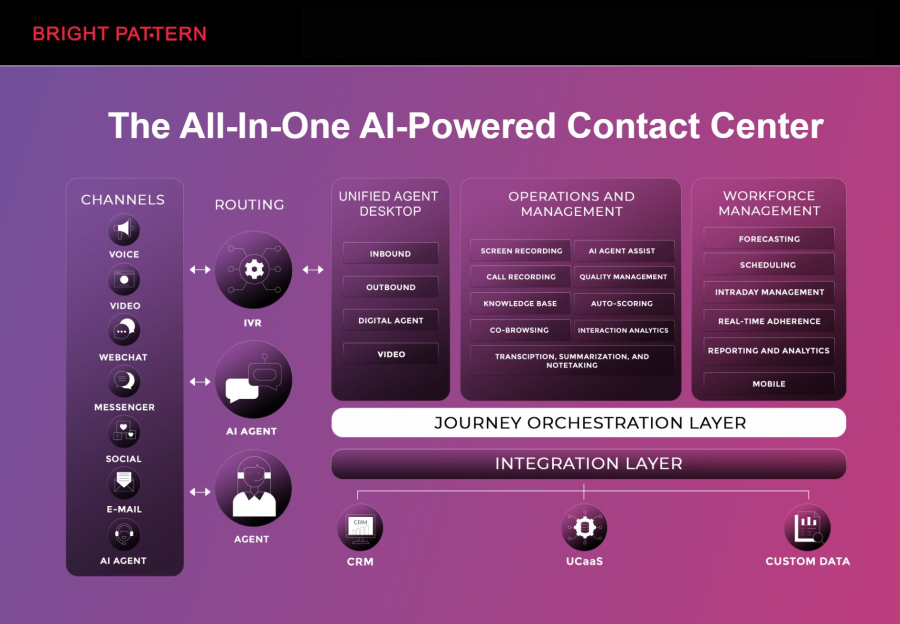
Bright Pattern leads the market in AI for contact centers with an intuitive platform that combines AI-powered routing, omnichannel support, and advanced analytics. Its voicebot AI and predictive engagement tools allow agents to focus on complex interactions while routine queries are handled automatically. Bright Pattern’s platform also integrates seamlessly with CRM systems, providing a complete view of customer interactions and enabling hyper-personalized service. Its cloud-based architecture ensures scalability for fast-growing call centers, making it a trusted choice for enterprises looking to reduce operational costs while improving customer satisfaction.
2. Genesys Cloud CX
Genesys Cloud CX uses AI-driven insights to automate workflows, predict customer needs, and provide agents with real-time guidance. Its conversational AI solutions enable seamless chat, voice, and messaging interactions.
3. Five9 Intelligent Cloud Contact Center
Five9 offers cloud-based AI solutions with predictive dialing, automated call routing, and workforce optimization tools, helping businesses manage customer interactions efficiently.
4. NICE inContact CXone
CXone combines AI, analytics, and omnichannel routing to deliver smarter, more efficient contact center operations. Its AI capabilities help predict customer intent and enhance agent performance.
5. Talkdesk AI
Talkdesk leverages AI to analyze conversations, automate repetitive tasks, and provide agents with contextual insights to improve customer experiences.
6. RingCentral Contact Center
RingCentral integrates AI-powered chatbots, sentiment analysis, and real-time analytics to optimize interactions and reduce handling times.
7. Avaya OneCloud CCaaS
Avaya’s AI-enabled platform uses machine learning to predict call volumes, automate routine inquiries, and guide agents through complex scenarios.
8. Zendesk AI
Zendesk’s AI tools help streamline ticketing, offer intelligent self-service options, and provide agents with AI-driven suggestions to enhance customer support.
9. HubSpot Service Hub
HubSpot Service Hub uses AI to automate follow-ups, provide predictive insights, and personalize customer support, enabling better engagement and retention.
10. Cisco Webex Contact Center
Cisco Webex integrates AI-driven analytics, virtual assistants, and smart routing to create efficient, customer-focused contact center operations.
The Business Case: Why AI Belongs in Your Contact Center
AI in contact centers delivers clear, measurable business value. When rolled out thoughtfully, organizations typically see improvements in both customer experience and operational efficiency.
Key performance metrics AI can improve
AI can positively influence most of the metrics that leaders track every day:
- Customer satisfaction (CSAT) and NPSthrough faster, more accurate, and more personalized responses.
- First contact resolution (FCR)by giving customers and agents instant access to the right information.
- Average handle time (AHT)by automating data entry, note taking, and information lookup.
- Cost per contactby shifting routine interactions to AI and increasing agent productivity.
- Agent retention and engagementby removing repetitive tasks and reducing burnout.
- Revenue per interactionthrough smarter upsell and cross sell suggestions.
The table below summarizes how AI can change the profile of a typical contact center.
Area | Traditional contact center | AI‑enhanced contact center |
Availability | Business hours; limited after‑hours coverage | 24 / 7 self‑service plus intelligent escalation to agents |
Wait times | Queues grow quickly during peaks | AI resolves common issues instantly, reducing queues |
Consistency | Answers vary by agent and shift | Standardized AI knowledge plus agent guidance |
Agent workload | High volume of repetitive questions | Routine queries handled by AI; agents focus on complex cases |
Insight and reporting | Sample based QA and manual analysis | 100 percent call and chat analysis with real time insights |
Core Use Cases of AI in Contact Centers
AI can be woven into nearly every stage of a customer interaction. Below are the most impactful and widely adopted use cases.
1. AI‑powered self‑service and virtual agents
AI driven virtual agents and chatbots are often the first touchpoint for modern contact centers. They can sit on your website, mobile app, messaging channels, or IVR, offering fast and convenient self‑service.
Typical tasks they handle include:
- Answering frequently asked questions about products, policies, or accounts.
- Processing simple transactions such as password resets, order status checks, or appointment bookings.
- Collecting initial information to speed up resolution when an agent takes over.
- Providing step by step troubleshooting for common technical issues.
Because AI virtual agents are available around the clock, customers get help whenever they need it. At the same time, human agents are freed from routine requests and can focus on higher value conversations.
2. Real time agent assist
Agent assisttools act like a smart co‑pilot during live interactions. As customers talk or type, the AI listens in the background and provides immediate support to the agent.
This can include:
- Surfacing relevant knowledge base articles and policies based on the conversation.
- Suggesting next best actions, offers, or troubleshooting steps.
- Auto filling forms and CRM fields with verified customer data.
- Creating real time summaries and call notes for post‑interaction wrap up.
The impact is powerful: agents spend less time searching for information and more time truly helping the customer. New hires ramp up faster because expertise is always at their fingertips.
3. Intelligent routing and personalization
Traditional routing often uses simple rules such as language, skill group, or queue priority. AI enabled routing goes much further, taking into account context, history, and predicted needs.
With AI, contact centers can:
- Analyze the customer’s intent and emotional tone before connecting them to an agent.
- Match customers with the best available agent based on skills, performance, and topic expertise.
- Prioritize high value or high risk interactions for faster handling.
- Offer personalized messages, recommendations, or scripts tailored to each customer.
This creates a smoother, more relevant experience for customers and improves agent productivity by freeing them to work on cases where they can have the most impact.
4. Automated quality monitoring and coaching
Manual quality assurance typically reviews a small sample of calls and chats, leaving many opportunities unseen. AI changes this by analyzing 100 percent of conversations across voice and digital channels.
AI powered quality and analytics can:
- Automatically score interactions for key behaviors such as greeting, empathy, and compliance.
- Detect emerging issues, product defects, or process bottlenecks from customer comments.
- Highlight coaching opportunities and best practice examples for supervisors.
- Identify top performing agents and replicate their approaches across the team.
As a result, contact centers can improve quality faster, with data driven coaching and a continuous feedback loop.
5. Workforce management and forecasting
Matching staffing levels to demand is a constant challenge. AI helps contact centers forecast volume more accurately and schedule teams in a way that balances service levels and cost.
Typical AI contributions include:
- Analyzing historical data and external factors to predict spikes and lulls in contact volume.
- Optimizing schedules across channels, skills, and time zones.
- Recommending intraday adjustments, such as moving agents between queues or channels.
Better forecasting and staffing mean shorter waits, higher service levels, and lower overtime, all without sacrificing the customer experience.
6. Insights for product, marketing, and operations
Every customer conversation contains valuable insights about products, processes, and brand perception. AI turns those unstructured interactions into structured intelligence.
Using speech and text analytics, organizations can:
- Identify the most common reasons customers contact support and fix root causes.
- Spot emerging trends in customer needs or product usage.
- Measure sentiment and brand perception over time.
- Feed real customer language into marketing, sales, and product roadmaps.
This breaks the contact center out of its silo and positions it as a strategic hub of customer insight for the entire business.
Step by Step: How to Implement AI in Your Contact Center
Successful AI adoption is not about switching everything on at once. It is about choosing the right use cases, starting where value is clear, and scaling from there.
1. Clarify goals and success metrics
Before you evaluate tools, define what success looks like for your business. For example:
- Reduce average handle time by a specific percentage.
- Increase self‑service containment for top contact reasons.
- Improve CSAT or NPS scores within a target time frame.
- Cut new agent onboarding time.
Clear goals make it easier to select the right AI capabilities and measure impact.
2. Prioritize high value, low risk use cases
Start with use cases that are frequent, repetitive, and well documented. Examples include order status checks, account balance queries, or policy information.
These interactions are ideal for AI because they are simple, consistent, and represent a large share of volume. Wins in these areas build momentum and internal confidence for broader AI adoption.
3. Prepare your knowledge and data
AI is only as strong as the knowledge and data it can access. Investing in clean, up to date content and well structured data pays off quickly.
Focus on:
- Centralizing FAQs, troubleshooting guides, and policies.
- Ensuring product and account data is accurate and accessible.
- Documenting clear step by step resolutions for common issues.
This preparation helps AI deliver precise answers and recommendations from day one.
4. Design seamless human handoffs
The best customer experiences come from AI and humans working together. That means ensuring that when a case needs a human, the transition is smooth.
Effective handoff design includes:
- Transferring full context and conversation history from AI to the agent.
- Allowing customers to request an agent at any time.
- Letting agents see what the AI already tried so they can avoid repeating questions.
When customers feel they are being helped, not bounced around, trust and satisfaction rise.
5. Empower and involve your agents
Agents are central to AI success. Position AI as a tool that removes friction from their day, not as a replacement. Involve them early by asking:
- Which tasks slow you down the most?
- Where do you spend time on low value work?
- What information do you wish you had instantly during calls?
Their input will help you prioritize features like knowledge suggestions, automated after call work, or better screen pops. As agents experience the benefits, adoption and satisfaction rise together.
6. Launch, learn, and optimize continuously
AI systems improve with use. Monitor performance closely after launch and refine based on real customer and agent feedback.
Strong optimization practices include:
- Reviewing conversations where AI did not resolve an issue and updating content or flows.
- Fine tuning intents and models as new topics emerge.
- Using analytics to identify additional automation opportunities.
This ongoing cycle keeps your AI aligned with evolving products, policies, and customer expectations.
Realistic Outcomes: What You Can Expect From AI
While every organization is different, certain benefits show up consistently for teams that invest in AI for their contact centers.
Higher customer satisfaction and loyalty
Customers value fast, accurate help that respects their time. AI contributes by:
- Providing instant answers for simple questions.
- Reducing wait times for more complex issues.
- Enabling agents to focus fully on listening and problem solving.
When customers feel heard and helped, satisfaction and loyalty naturally increase.
Lower costs without compromising quality
AI allows contact centers to handle higher volumes at a lower cost per interaction. Savings come from:
- Deflecting or fully resolving routine contacts through self‑service.
- Shortening handle times and wrap up time for agent assisted calls.
- Optimizing staffing so resources match demand more closely.
Importantly, this cost efficiency does not require sacrificing service quality. In many cases, the experience is actually better for both customers and agents.
More engaged and effective agents
By automating repetitive work and surfacing real time assistance, AI makes the agent role more rewarding and sustainable.
Agents benefit from:
- Less time on manual data entry and more time on meaningful problem solving.
- Faster access to information, which builds confidence during complex calls.
- More targeted coaching and recognition based on objective analytics.
This leads to lower attrition, stronger performance, and a more positive culture in the contact center.
Stronger alignment with the rest of the business
AI driven analytics give leaders a clear line of sight into customer needs and friction points. These insights travel far beyond the contact center.
Other teams can leverage this intelligence to:
- Improve product design and fix recurring issues.
- Refine marketing messages using the language customers actually use.
- Adjust policies or processes that trigger avoidable contacts.
The result is a business that responds more quickly and accurately to customer reality.
Future Trends: Where AI in Contact Centers Is Headed
AI capabilities are advancing rapidly, opening new opportunities for contact centers to differentiate their customer experience.
More natural, human like conversations
Advances in natural language understanding and generation are making virtual agents and agent assist tools sound more fluid, empathetic, and context aware. Customers increasingly experience AI that feels like a helpful, knowledgeable guide rather than a rigid script.
Proactive and predictive support
AI is moving beyond reactive service. By analyzing patterns across data sources, contact centers will be able to anticipate needs and reach out before issues arise, for example by:
- Alerting customers to potential problems and offering solutions in advance.
- Recommending optimizations or new features based on usage patterns.
- Flagging at risk customers and proactively offering support or offers.
Deeper integration across channels
Customers expect to move seamlessly between web, mobile, messaging, and voice without repeating themselves. AI will play a central role in stitching together context and history across these channels, giving both customers and agents a continuous conversation experience.
Practical Checklist: Are You Ready for AI in Your Contact Center?
If you are exploring AI, use this quick checklist to assess your readiness and focus areas:
- StrategyDo you have clear goals and metrics for AI?
- Volume and use casesDo you have high frequency, repetitive contacts to automate?
- Knowledge and dataIs your content accurate, centralized, and easy to access?
- Technology foundationsCan your current systems integrate with AI tools?
- People and cultureAre your leaders and agents engaged in the AI journey?
Even if some of these elements are still in progress, starting with a focused pilot can generate results and insights that accelerate your broader transformation.
Conclusion: Turn Your Contact Center Into a Strategic Advantage
AI for contact centers is about more than automation. Used thoughtfully, it is a powerful lever for better customer experiences, more engaged agents, and stronger business performance.
By combining AI powered self‑service, intelligent routing, real time agent assist, and deep analytics, organizations can create a contact center that is always on, always learning, and always improving. Customers get faster, more personalized help. Agents gain tools that make their work more impactful. Leaders gain clear data to guide strategic decisions.
The organizations that start building their AI capabilities today will set the standard for customer service tomorrow. With a clear strategy, the right use cases, and a focus on human centered design, your contact center can become a true competitive advantage powered by AI.
